
SketchBot wins 1st Place for Best New Product at IAAPA awards!

A B R I E F H I S T O R Y

AUGUST 2018
Picture Mosaics starts building the world’s first Ai machine learning model to allow a robotic arm to sketch portraits

APRIL 2019
Picture Mosaics completes the world’s first machine learning Ai model. The Alpha Model (v1 model) is born. The Ai model is trained by real artists

MAY 2019
First end-to-end test with robotic arm drawing sketches with the Alpha Model (v1 model)
JUNE 2019 TO JUNE 2021

The search for a robotic arm manufacturing partner that is reliable, fast, & accurate. Beta Ai Model (v2 model) is trained & released. Partner confirmed July 2021

FEBRUARY 2022
SketchBots are debuted at PBX 2022 with Beta Model (v2)
MARCH 2022 - JANUARY 2023: R&D AND TESTING
FEBRUARY 2023

SketchBot technology enters Patent Pending status, & SketchBots are released to the market with the new Gamma Model (v3)

JULY 2023
SketchBot Ai model Delta (v4) is released, the most accurate & artistic model to date
AUGUST 2023 - JANUARY 2024: SOFTWARE IMPROVEMENTS / R&D
FEBRUARY 2024

SketchBot Epsilon Model (v5) is released, and SketchBot Color is debuted
JUNE 2024

Crayola selects SketchBot to be a part of their interactive experience locations
NOVEMBER 2024

SketchBot Pro, with the ability to autonomously exchange tools, is debuted at IAAPA 2024

FEBRUARY 2025
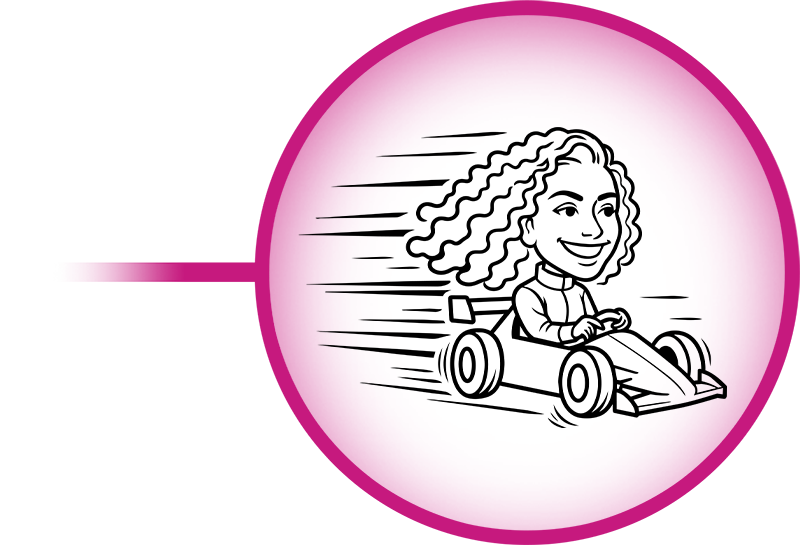
Debut of SketchBot Caricatures
JUNE 2025

Personality Test (Beta) interprets your unique traits to create a thematic portrait true to you
In addition to 4×6” sketch, SketchBots support four additional sizes: 5x7”, 6×8”, 8x10", and 8.5x11"
Dream Studio Mode is introduced
JANUARY 2026
Sketches transform into animated mini-clips that jump off the paper and onto your device and the big screen
FEBRUARY 2026
APRIL 2026
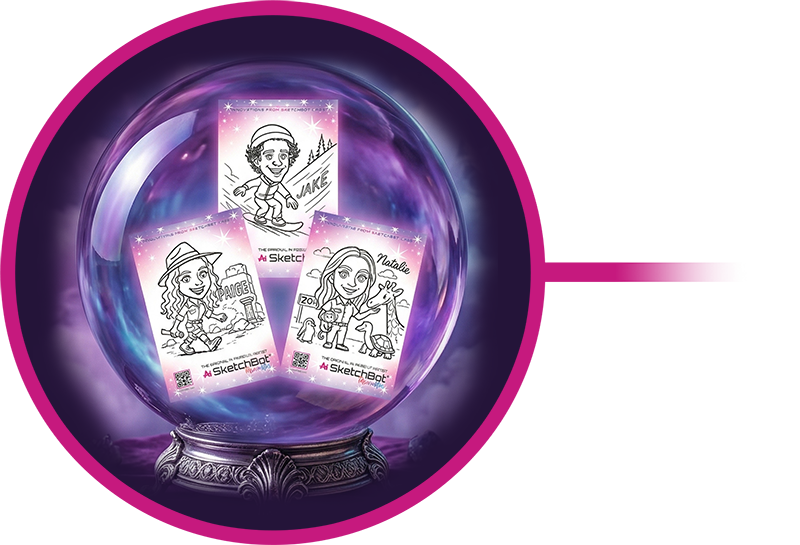
Future Teller (Beta) provides a personalized insight into your path ahead or a deep dive into your inner aura
APRIL 2026
The Full SketchBot History
History & Origins
The concept for SketchBot was born in 2018. Picture Mosaics LLC, a company founded in 2001 that specialized in photo technologies and interactive mosaic experiences, was seeking new, engaging ways for users to interact with physical photography.
The technology was co-invented by two brothers: Albert (Al) Charpentier and Joseph (Joe) Charpentier. Albert applied his background in electrical engineering, which included previous experience working for AMD, while Joseph utilized his background as a software developer to build the necessary AI algorithms and software platforms.
The initial development phase to build and train the Ai model, as well as to identify the perfect robotic arm form factor, took approximately eight to ten months.
Software & Ai Processing
Between 2018 and 2025, SketchBot's Ai models underwent continuous iteration. The development team hired human artists to help perfect the Ai’s drawing quality, ensuring the digital processing translated accurately into physical sketches.
The AI operates quickly, allowing the robotic arm to complete a customized sketch in anywhere from 45 seconds to one and a half minutes. The system relies on two primary processing methods:
Local Model: A system where all AI processing and robotic controls are handled locally on a connected PC or Mac.
Cloud Model (Dream Studio): Launched in 2025, this model leverages cloud computing to process the AI artwork, ensuring advanced rendering capabilities and helping SketchBot maintain its technological dominance into 2026 and beyond.
Hardware Iterations
Since its inception, the physical hardware of the SketchBot has evolved across multiple configurations:
Standard Platform: The original 2018 prototype featured a robotic arm sketching onto 4x6 inch paper that was temporarily secured with nano-tape to a three-inch-high platform.
Spring-Loaded Platform: This patent-pending upgrade securely holds up to 150 sheets of paper without moving during the sketching process. It automatically dispenses the next sheet to streamline operations. By 2025, the platform ecosystem was expanded to accommodate larger paper sizes, including 5x7, 6x8, 8x10, and 8.5x11 inches.
SketchBot Pro: A fully enclosed, self-service kiosk mounted on an acrylic pedestal. The Pro system uses a magnetic tool exchanger that automatically swaps the drawing marker for a pusher tool, allowing the robot to slide the finished 4x6 inch sketch directly out to the guest. Designed for unattended use in museums, family fun centers, and high-traffic areas, the kiosk includes a payment terminal that accepts credit cards or game cards for sketches priced between $5 and $20.
User Experience & Features
The standard SketchBot interaction involves a user walking up to an iPad kiosk, taking a photo, and selecting a drawing theme (such as an astronaut, baseball player, or standard portrait).
Recent software advancements have introduced new interactive modes:
Visual Personality Test: Instead of manually choosing a theme, users can complete a four-to-five question visual test on the tablet. The AI uses their answers to select a custom drawing theme or hobby that best matches their personality.
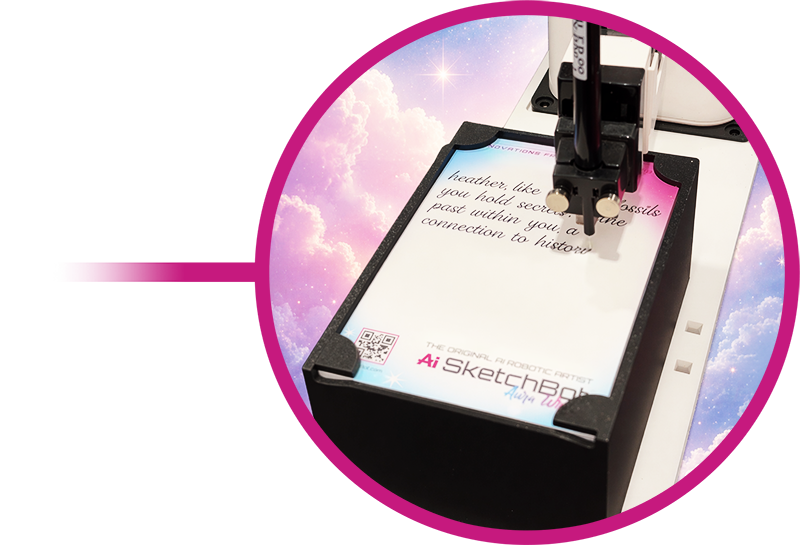
Text Writing and Fortune Telling: The robotic arm has the capability to write human-like text. This is often used for a "fortune teller" experience, where the robot writes a forward-looking message for the user and signs the bottom with a small design or stamp.
Product Extensions
SketchBot Color: Currently in beta, this system utilizes the tool exchanger from the SketchBot Pro. The robotic arm can automatically swap between 8 and 16 different colored markers to fully color in the sketches.
Market Application & Education
SketchBots are highly popular within the event industry, frequently deployed at worldwide trade shows, conferences, weddings, and birthday parties. The visual nature of the drawing robot often results in viral social media moments; an estimated 85% of users record the robot drawing their portrait to post on platforms like TikTok and Instagram.
While imitator systems began emerging in 2022, SketchBot hardware is noted to draw two to three times faster than competing copycats, while relying on far superior AI models.
Beyond entertainment, the technology serves as a STEM (Science, Technology, Engineering, and Mathematics) educational tool. Colleges, universities, and schools purchase the robots to provide students with a tangible, easily digestible example of how artificial intelligence and machine learning can interact with the physical world through robotics.
Intellectual Property
Picture Mosaics LLC has actively pursued intellectual property protection for the system since its creation in 2018. The company holds pending patents across its entire technology stack, covering the software processing, physical hardware, SketchBot Pro Kiosk, and SketchBot Color systems.